Showing posts with label lost pet. Show all posts

Monday, June 11, 2012

Feral Cats - Wild Animals, Not Stray Pets

According to the Humane Society of the United States, there are around 50 million feral cats in America. In this post, we'll take a look at feral cats and the controversy surrounding their treatment and care.

Probably a few feral cats live in your neighborhood. You may even have a sizable colony in your area and not know about it. If an outside cat does not appear to be friendly, there's a good chance that it is a feral - not a stray. A stray is a pet that has become lost, while a feral cat has never been a pet and is not friendly towards people (to put it mildly). These are cats that have little to no experience with humans. They are elusive, fearful, and do not trust people.

Feral cat on ECU campus, via Saving Graces
Feral cats live in colonies, clustered around an area where they can find food. The colony will defend its territory from other cats, though lone cats may also be accepted into the group. The life of a feral cat can be quite difficult, though the difficulty is mitigated to some extent with a reliable source of food and shelter. Many people choose to feed colonies of feral cats, and here is where the controversy begins.

Feeding operations quickly attract large numbers of ferals and strays
Feral colonies can be a nuisance, with lots of kittens, fights between males, and predation of the local bird and small mammal populations. In response, many communities routinely trap and euthanize ferals. However, this is not an effective solution as the ongoing trapping and euthanasia costs money and does not decrease the number of ferals in an area. Female cats can begin having kittens as early as five months, and they will continue to produce as many as five litters per YEAR. That's a lot of cats. Simply removing a colony means that a new one will just come in to take its place. The cycle is endless and frustrating.

Unless the cycle is stopped, this feral mama will continue to have multiple litters a year - and so will each of her female offspring.
Most animal welfare organizations, including the Humane Society of the United States, suggest Trap, Neuter, Return (TNR) as the most effective and humane way to combat the problem of ferals in a community. Under this program, the person who is feeding the colony systematically traps each member of the colony, has the animal spayed or neutered, and then returns them to the group. The cat also gets vaccinations as part of the deal, and their ear is tipped so the feeder knows which cats have already been fixed.

With TNR, the cats are allowed to live, but they are not allowed to produce more feral cats. The colonies stabilize in number, and without the added drama of breeding, males fight less, and females are much healthier. With a steady source of food, the cats hunt less, and the colony overall is much safer, happier, and more palatable to the humans that live around them.
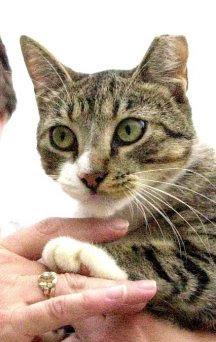
Greenville feral with tipped ear, via Saving Graces

Ferals are either the offspring of other feral cats, or of lost or abandoned pets. In order for a cat to be comfortable with people, they must be properly socialized during a critical phase of their young lives. Kittens under 8 weeks are relatively easy to socialize, while kittens of 8 weeks to 6 months take much more time and energy. Cats that reach six months without human contact will be extremely fearful of humans and usually too wild to socialize.

This is why HSEC does not accept feral cats. There are many well-socialized pets that need our help, and feral cats are not adoptable. They really would rather not live in your home. The shelter environment is even more stressful for ferals than for strays, and it is difficult for the staff to feed, medicate, and handle these wild animals.

There are organizations which provide help and care either specifically to ferals, or to ferals and stray cats. In Greenville, Saving Graces 4 Felines provides support for colony feeders who practice TNR. HSEC has also transported a small number of cats to Pigs, a sanctuary in West Virginia that specializes in rescuing pot-bellied pigs, and additionally serves as a home of last resort for less adoptable dogs, cats, and other farm animals.

Ghost, an HSEC alum now at Pigs Sanctuary

For more information, take a look at Saving Grace's feral information website and the Humane Society of America's feral cats FAQ, both of which have a lot of great details.

It may be strange to see a cat as a wild animal, but with the right management and support, these creatures can be just another part of the landscape.

Edited to add: the HSEC blog reserves the right to remove abusive comments. Opposing opinions are welcome provided they are composed in a respectful and appropriate manner.

Monday, February 27, 2012

Microchipping - bring your buddy home

Start talking about lost pets, and something happens. It doesn’t happen to everyone, but for a surprisingly large number of people, mention lost pets and they get a far-off, unhappy look in their eyes. And they’ll say something like,

“When I was a kid our dog slipped the leash and ran away,”

Or,

“We had a cat who got out the door and never came back.”

If you’re one of this number, you know exactly how this feels. And even if that pet vanished years ago, the memory of it still brings sadness. According to foundanimals.org, one in three pets will get lost at some point in their lives. Without proper ID, 90% will never return home.

Of course, there are a few things that you can do to minimize the chances that your pet will get lost. A correctly fitted collar with tags, a secure backyard, etc. But there’s one thing that even conscientious pet owners often overlook; something that will ensure that your animal can be returned to you even if it loses its collar and hitchhikes to California: microchipping.

Because when pets get lost, they don’t just vanish. And contrary to popular belief, pets, especially cats, have a pretty decent shot of surviving on their own, at least long enough to find their way to a new friendly human. HSEC, Pitt County Animal Shelter, and other similar organizations take in hundreds of animals from this county every year. Many of those are just lost pets, animals that have a loving home they’ve become separated from.

Size of microchip

Microchips are a small implant, about the size of a grain of rice, that is usually inserted between a pet’s shoulder blades. The microchip is an identifying integrated circuit that can be read by a special wand. When a lost pet arrives at the HSEC, enters the shelter system, or is brought to a vet’s office, a wand is used to determine whether the animal has a microchip. And if they do - ta-da! - the pet can be quickly reunited with its owners.
It only hurts for a second!
Microchips significantly decrease the money the rescue group needs to spend on rehoming the animal, and increase the likelihood that your lost buddy will be found. If everyone microchipped their pet, numbers of animals in the shelter system would decrease dramatically. The procedure usually has few or no side effects and is only as painful as getting an ordinary vaccine. The cost is low, and in 99% of cases the microchip never has to be replaced.

After the chip is placed, the number must be registered in a database so the animal can be connected back to you. You should also have your vet scan for the chip at each check-up, to make sure that it is still in place. And please note that a microchip does NOT REPLACE external ID like a collar and tags.
Scanning for a microchip
Most veterinarians offer microchipping. And if you’d like to use this as an opportunity to help out HSEC, consider having your pet microchipped at our Canine Crawl event, Sunday, March 25th, 12-4 on the Town Common in Greenville. Canine Crawl will also feature a charity walk, vendors, an agility course, vet Q&A, dog wash, and even a doggie pageant, so there’ll be plenty to take your buddy’s mind off that little pinch in his back.

So please take some time to consider if microchipping is the right decision for your pet. It's not pleasant to think about your fuzzy friends getting lost, but a microchip could make all the difference in getting them back home.